5.4 Hydrogen Bonds
1 Exercise
5.5 Dative Bonds
1 Exercise
5.6 Metallic Bonds
1 Exercise
5.7 Ionic and Covalent Compounds
1 Lesson | 1 Exercise
06 Acids, Bases and Salts
6.1 The Role of Water in Acidic and Basic Properties
3 Lessons | 1 Exercise
6.2 Meaning of pH and Determination of pH
1 Lesson | 1 Exercise
6.3 Strength of Acids and Alkalis
1 Lesson | 1 Exercise
6.4 Chemical Properties of Acids and Alkalis
3 Lessons | 1 Exercise
6.5 Concentration of Aqueous Solution
2 Lessons | 1 Exercise
6.6 Standard Solution
2 Lessons | 1 Exercise
6.7 Neutralisation
2 Lessons | 1 Exercise
6.8 Salts, Crystals and Their Uses in Daily Life
1 Lesson | 1 Exercise
6.9 Preparation of Salts
4 Lessons | 1 Exercise
6.10 Action of Heat on Salts
2 Lessons | 1 Exercise
6.11 Qualitative Analysis
3 Lessons | 1 Exercise
07 Rate of Reaction
7.1 Determining The Rate of Reaction
2 Lessons | 1 Exercise
7.2 Factors Affecting the Rate of Reaction
1 Lesson | 1 Exercise
7.3 Applications of Factors that Affect the Rate of Reaction
1 Lesson | 1 Exercise
7.4 The Collision Theory
1 Lesson | 1 Exercise
08 Manufactured Substances in Industry
8.1 Alloys and Their Importance
1 Lesson | 1 Exercise
6.3.1 Strength of Acids and Alkalis
Strong Acids and Weak Acids
- Acids are chemical substances that ionize/dissociate in the presence of water to produce hydrogen ions (or hydroxonium ions).
- Acids can be classified into 2 categories:
- Strong acids
- Weak acids
- The strength of an acid depends on the degree of ionization/dissociation of the acid.
Strong Acids
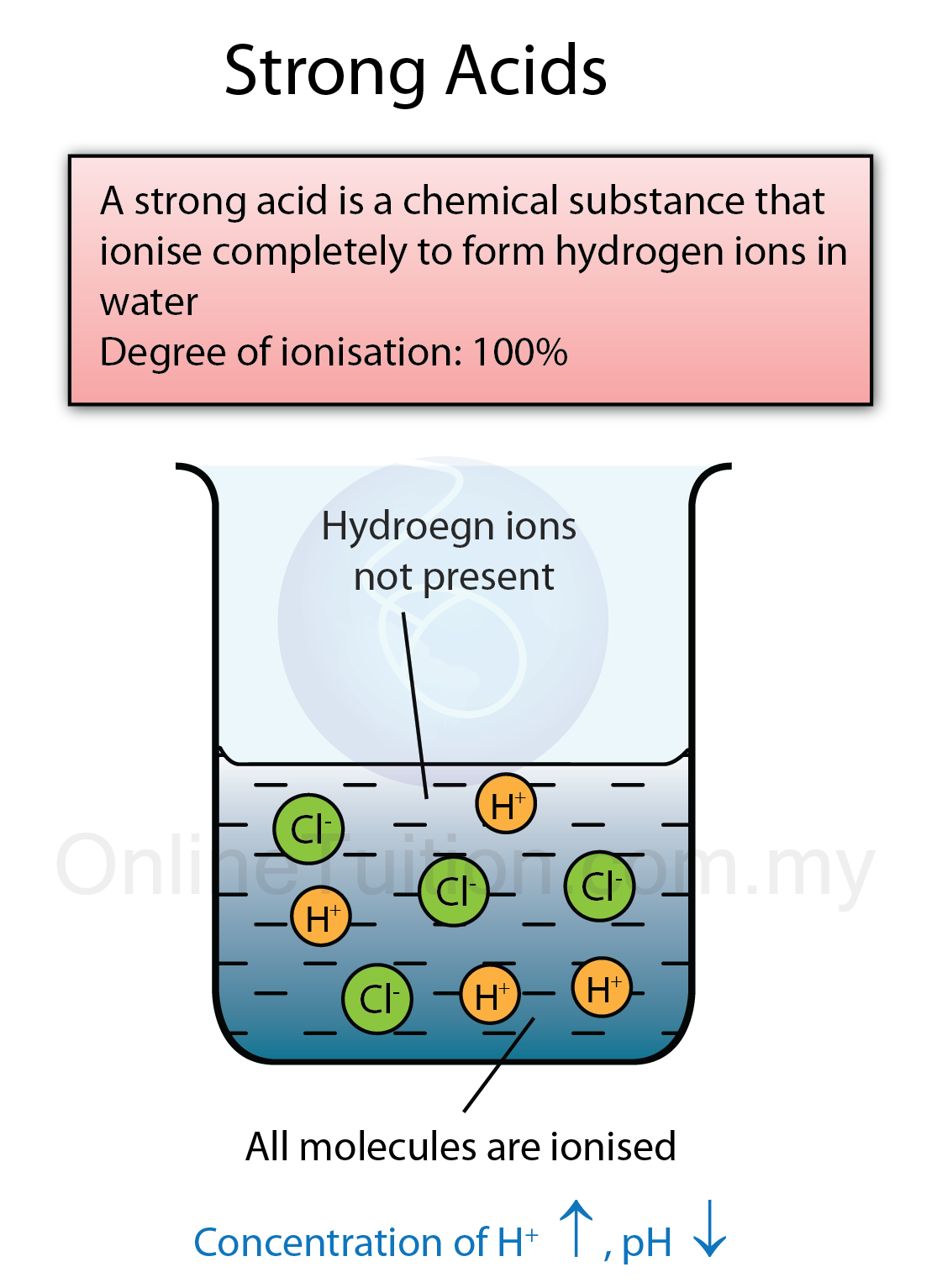
Strong acids are acids that ionise completely to form hydrogen ions in water.
Examples:
Sulphuric acid
Hydrochloric acid
Nitric acid
Weak Acids

Weak acids are acids that partly ionise to form hydrogen ions in water.
Examples:
Ethanoic acid
Phosphoric acid
Citric acid
Strength of Alkali
- Similar to the strength of acids, the strength of an alkali is defined by its ability to ionise and release hydroxide ions (OH–) in the solution.
- In a solution of strong alkali, all the alkali molecules are ionised in the water to produce hydroxide ions.
- In a solution of weak alkali, only a small portion of the molecules are ionised to release hydroxide ions.
- The table below shows some example of strong/weak alkalis.
Alkali | |
Strong | Weak |
| NaOH KOH LiOH | NH3 |